Roots Function
The roots() function is used to numerically find roots for a system of nonlinear equations. It can take either two or three arguments:
The system of functions is given in 1:vector. It returns the value of 2:vector that makes the set of functions in 1:vector equal to zero. The third argument, 3:vector, is the vector of guess values. It can also be used to find the root of a single equation.
Here is an example showing how to use roots() for a single equation and for a system of equations:
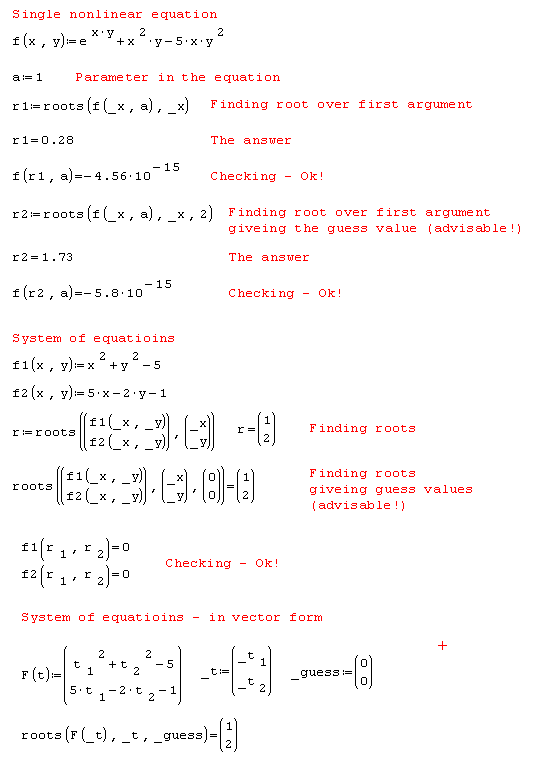
Note: 1:vector must be a user-defined function returning a vector in the given variables, and 2:vector must be a vector of symbolic variables (it must not be given numerical values). When using roots(), make sure the variables you're searching for roots of haven't already been assigned numerical values.
Here is another example, solving a system of linear algebraic equations. The system was solved both using matrices and using roots():
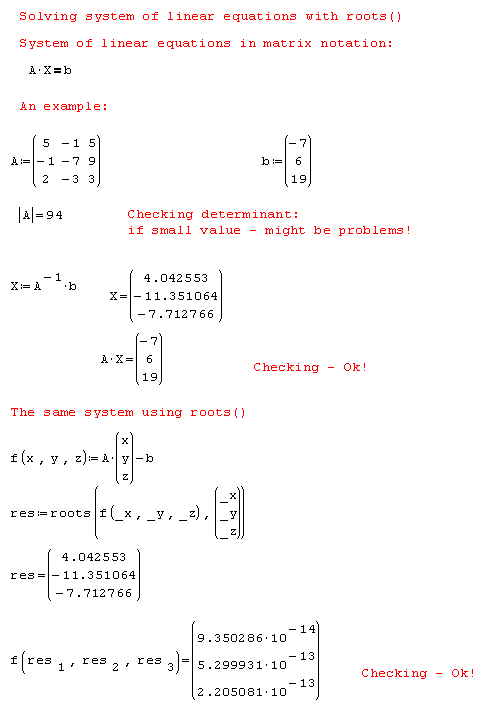
Note: if the determinant of a system's matrix is close to zero (an ill-conditioned system), there is a good chance roots() will have trouble with it.
For a broader overview of solving equations in SMath Studio, including solve() and polyroots(), see Solving Equations.
This page is based on a legacy wiki article by Radovan Omorjan.